Main Product
Our company's products are widely sold in multiple countries
Travel lift procurement prices are not simply rated capacity times a unit price. Standard models use mature structures, standardized parts, and conventional configurations. Their initial purchase price is usually lower. Custom models are designed around vessel type, dock layout, ground bearing, lifting points, and working environment. Their prices naturally rise. This article separates core differences between standard and custom travel lift solutions. It also covers price composition, long-term operating costs, and budgeting methods. It explains why buyers should not focus only on equipment quotes. There are one-time purchase costs and later operating costs. We draw on HSCRANE travel lift project delivery experience. This gives more practical selection and inquiry ideas.
Planning a travel lift procurement project?
Travel lift procurement prices depend on capacity, equipment span, lifting configuration, and working environment. Whether you consider standard equipment or custom solutions, clear requirements early help control procurement budgets. HSCRANE can provide preliminary selection advice based on your actual working conditions.
[Contact HSCRANE for travel lift procurement consultation]
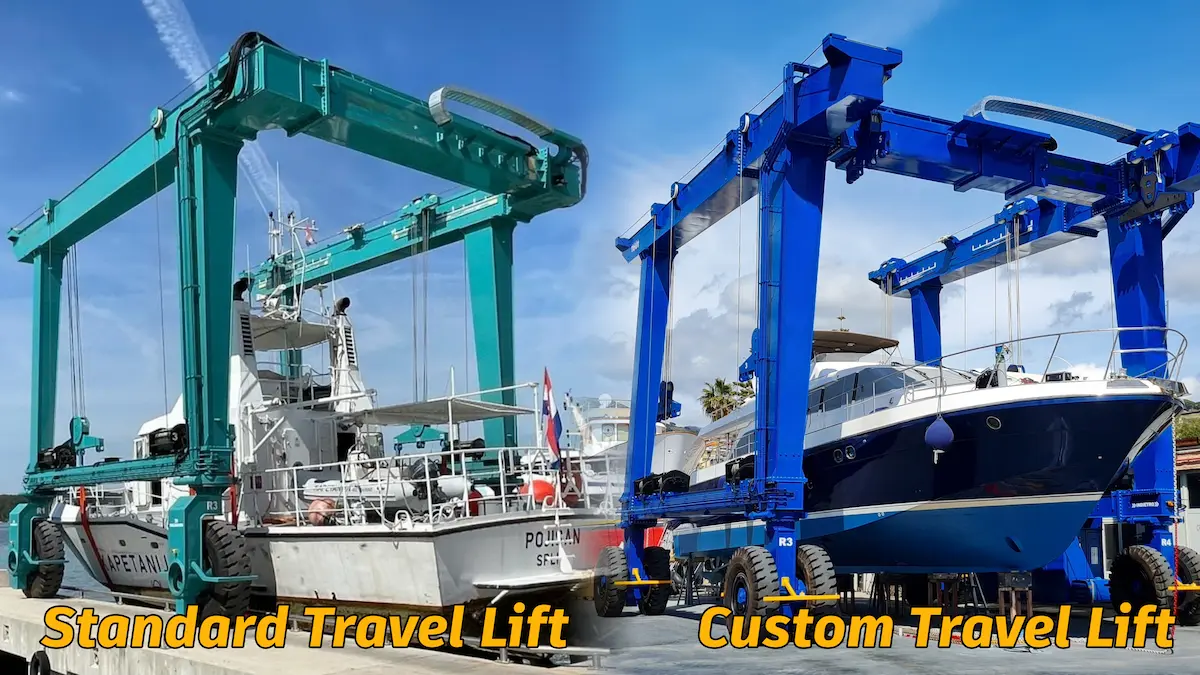
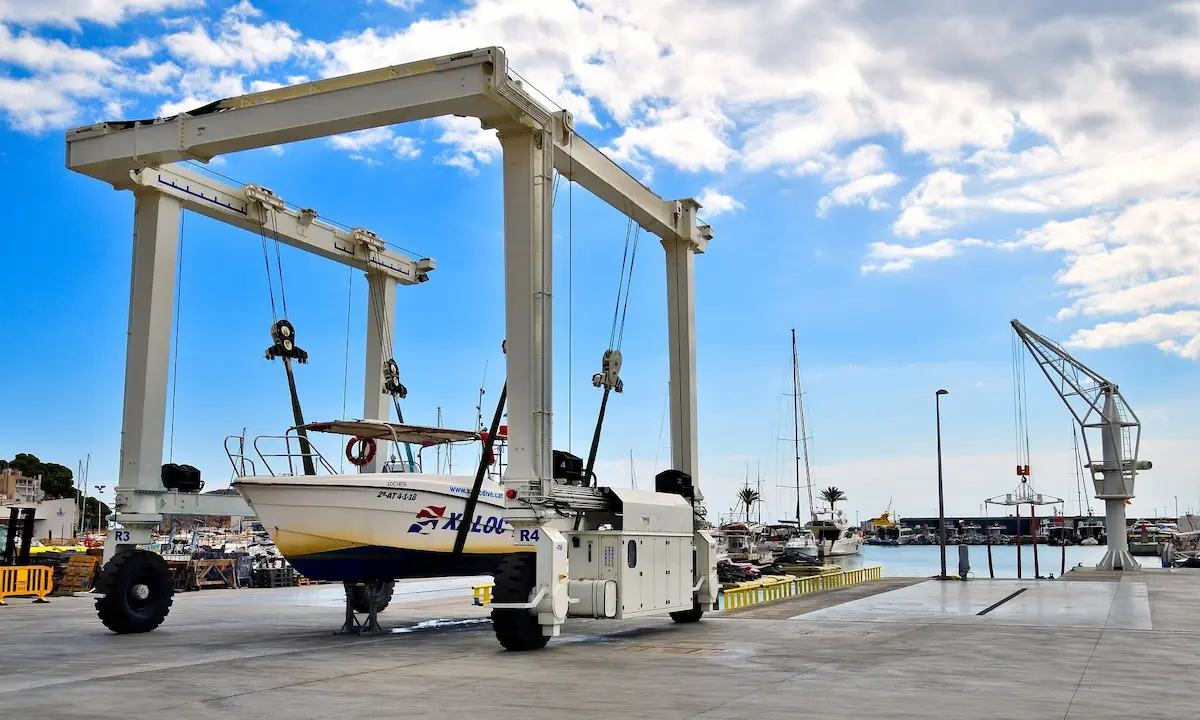
Standard does not mean “low specification.” It is a mature package for common travel lift needs at docks and shipyards. Travel lift procurement buyers usually value two points. The configuration is sufficient, and the price is relatively controllable. The premise is that your working scenario truly fits its scope.
●Common capacity and span configurations: They cover common yacht tonnage ranges and dock spans. Capacity, span, and lifting height are relatively fixed. You can select against vessel type and berth directly. But rated capacity is only a selection entry point. It cannot replace checks of beam, hull structure, and lifting point layout.
●Standard gantry structure and lifting height: It uses a mature gantry form. Lifting height is set for conventional docks and repair sites. Structural calculation, manufacturing, and assembly processes are stable. It suits projects with conventional clearance and access channels.
●Conventional hydraulic drive and travel system: It handles common transfer, positioning, and lifting work at docks or shipyards. It is not designed for extreme slopes, very narrow passages, or complex steering. Confirm passage width, turning radius, and ground conditions before procurement.
●Standard sling quantity, layout, and lifting method: Sling quantity, spacing, and layout generally follow common hull widths and load conditions. This suits docks with relatively stable vessel types. If vessel spans are large or hull structures are special, assess lifting point fit carefully.
●Conventional electrical control and safety protection: It includes conventional electrical control, limit protection, emergency stop, and basic safety interlocks. These meet basic daily lifting operation and safety requirements. Write operation mode, control points, and interlock scope into the technical confirmation sheet. This avoids later disputes.
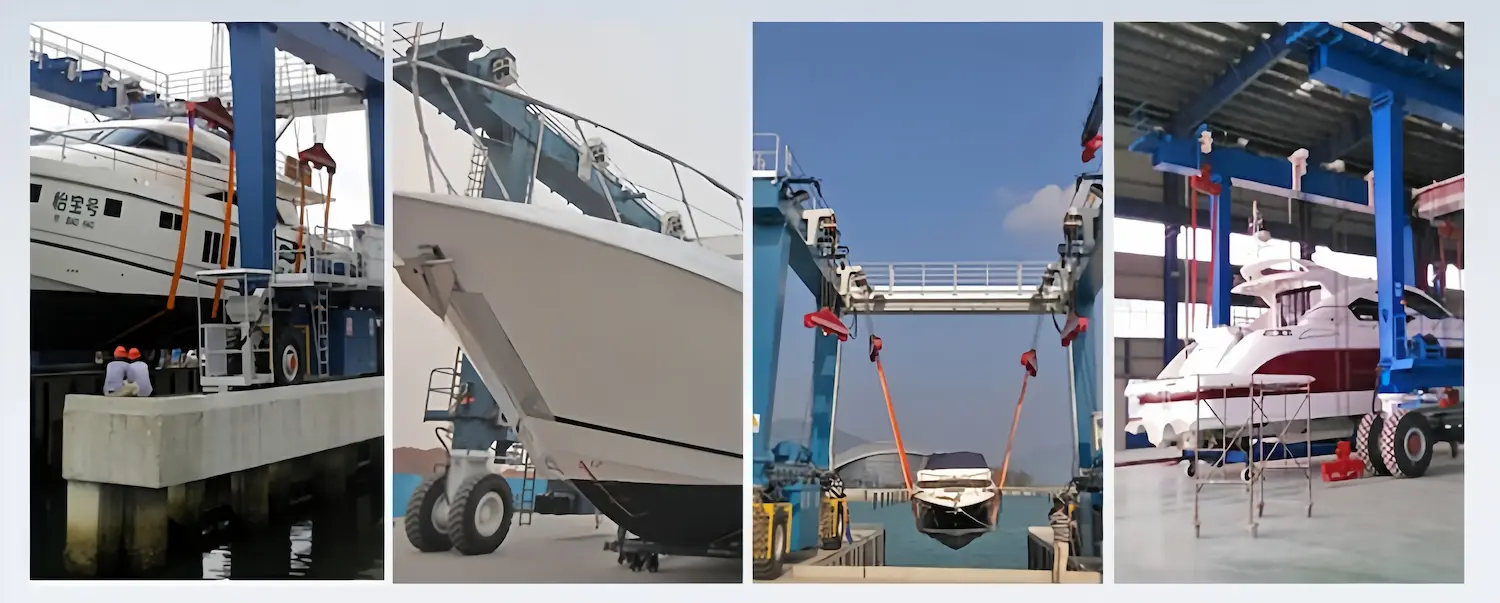
●Mature structures reduce repeated design: The structural solution has been verified across many projects. Each order does not need new structural calculations and drawings. Early technical documents are more complete. Solution confirmation is also faster.
●Standardized parts control manufacturing and procurement costs: Gantry profiles, hydraulic components, travel mechanisms, and sling connectors use common configurations. Procurement batches and production organization become smoother. Hidden costs from nonstandard machining and separate quotations also decrease.
●Conventional configurations ease production and delivery management: Assembly processes, commissioning points, and inspection items are relatively fixed. Factory scheduling and delivery uncertainty are usually smaller. Site installation and commissioning also follow more mature processes.
●Mature solutions reduce early communication costs: Ready parameter tables, configuration lists, and interface descriptions help procurement, users, and suppliers align. Many project delays come from early repeated confirmation, not manufacturing. The repeated question is whether a configuration is included.
|
Suitable procurement needs |
Why standard models fit better |
Points to check during procurement |
| Yacht docks with relatively fixed vessel types | Common capacity, span, and sling layout are easier to match. You avoid full custom design costs for a few special vessels. | Check maximum beam, hull structure, and future larger yacht tonnage. |
| Shipyards with conventional sites and bearing conditions | Standard gantries, conventional travel, and lifting heights fit existing sites more easily. Design and manufacturing cycles are relatively controllable. | Confirm passage width, turning radius, ground bearing, and slope are within the standard scope. |
| Repair sites with stable lifting frequency and processes | Daily processes are fixed, and conventional control and safety configurations are basically sufficient. Complex functions are unnecessary for low-frequency special conditions. | If night shifts, remote operation, or multi-boat work are frequent, reassess control and safety configuration boundaries. |
| Procurement projects with limited budgets and no special functions | Initial purchase prices are usually lower, and configuration lists are clear. Spare parts and routine maintenance are easier to manage. | Do not sacrifice basic safety protection to cut budgets. Confirm standard configurations cover local regulations and site requirements. |
Overall, standard models suit projects with clear needs, conventional scenarios, and bounded budgets. Passages may be very narrow, ground bearing limited, or vessel spans large. You may need multi-point synchronization, special anti-corrosion, or complex steering. Then do not force a standard model. Cost advantages hold only when the model matches. If it does not match, later configuration and site changes raise the total cost.
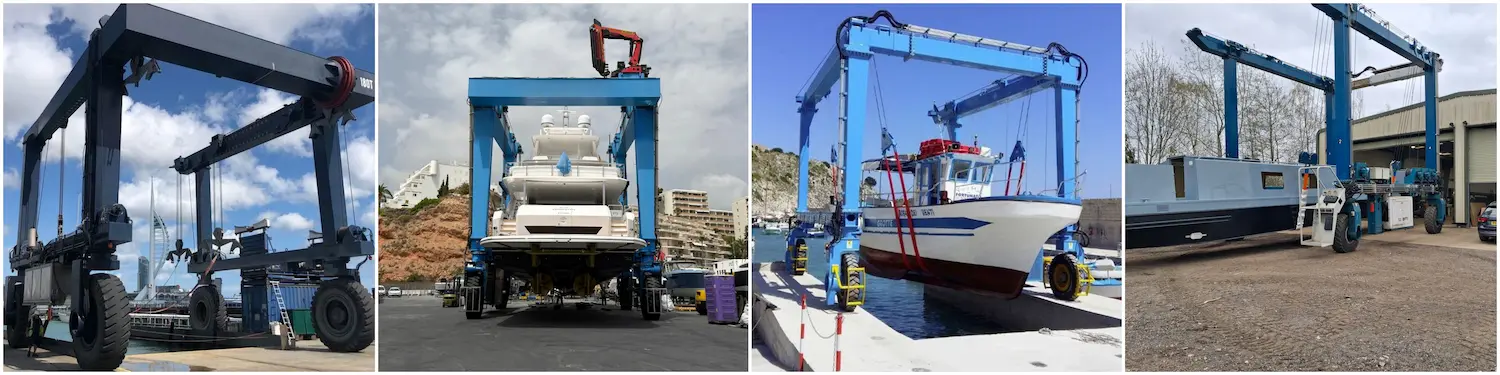
A custom travel lift is not simply a standard model plus a few options. It often starts a new solution from basic parameters. These include vessel type, site, ground bearing, and working environment. Therefore, price differences are not only in steel and components. They also lie in design, verification, non-standard manufacturing, and site service.
●Rated capacity adjusted for special vessel types: Rated capacity is adjusted for special vessel types. It is not simply scaled up. Recalculate it with hull weight distribution, lifting point reactions, and safety factors. The more special the vessel type, the more essential early parameter confirmation becomes.
●Span, clearance height, and wheelbase adjusted to site layout: Span, clearance height, and wheelbase adjust with site layout. Dock passages, berth spacing, shipyard workstations, and gantry access routes affect dimensions. Inaccurate site measurement makes later structural changes troublesome.
●Wheel count and wheel load distribution determined by ground bearing capacity: Wheel count and wheel load distribution depend on ground bearing capacity. Limited ground bearing may require more wheels to spread wheel loads. The travel system then becomes more complex. This part is easily underestimated. It directly affects steel structure and costs.
●Sling quantity, spacing, and lifting positions arranged by hull structure: Sling quantity, spacing, and lifting positions follow hull structure. High-value yachts are more sensitive to load points. Do not apply a template based only on tonnage. Confirm lifting points with hull reinforcement and owner requirements.
●Drive method and power system selected by working environment: Drive method and power system are selected by working environment. Salt spray, humidity, power conditions, and environmental requirements vary. Hydraulic and electrical selections also differ. State environmental conditions before inquiry. Do not add them after the solution is complete.
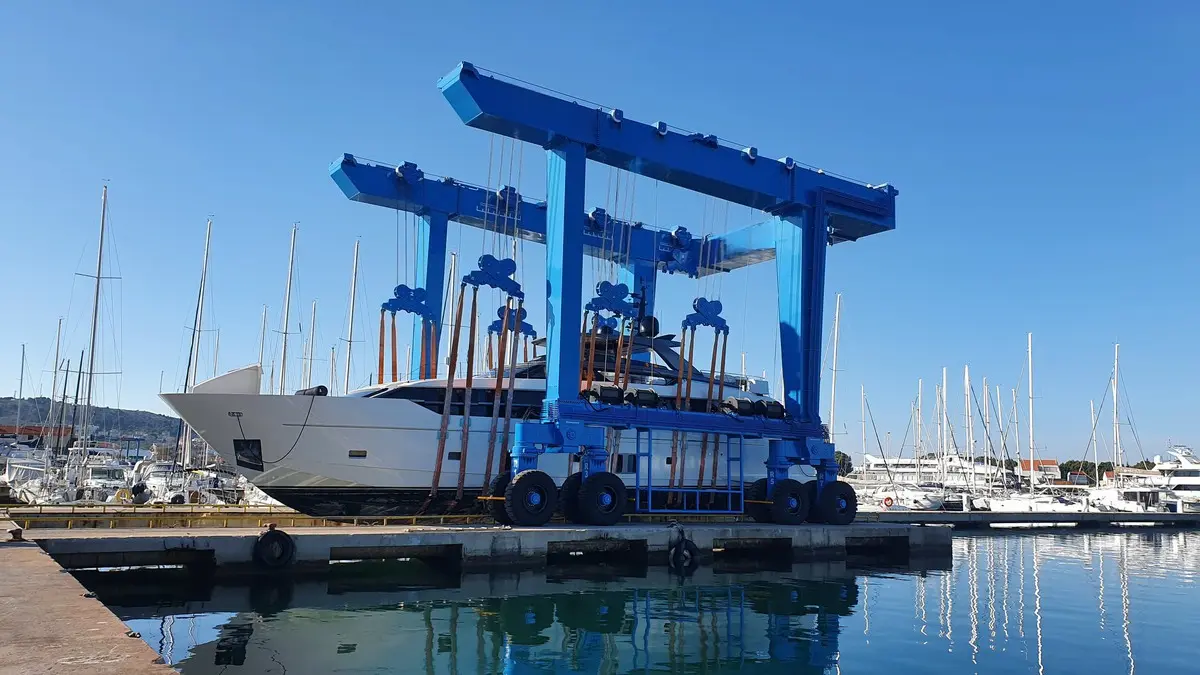
●Non-standard gantry structures and special steel structure designs: Non-standard gantry structures and special steel designs raise costs. If gantry form, height, or load path deviates from standard, redesign follows. Structural calculation, material selection, and manufacturing process must be redone. Costs naturally rise.
●Multi-wheel independent steering and complex travel systems: Multi-wheel independent steering and complex travel systems cost more. Narrow passages, many turns, or special sites may need multi-mode steering. Wheel sets, hydraulic control, and steering logic become more complex. It is not just adding wheels.
●Multi-point independent control and synchronous lifting systems: Multi-point independent control and synchronous lifting systems add cost. Independent adjustment, synchronous lifting, and load balancing increase hydraulic, electrical, and commissioning work. Sensor and control logic requirements are also higher.
●High-grade anti-corrosion coating and special environmental protection: High-grade anti-corrosion coating and special environmental protection raise costs. Marine environments, salt spray, and humidity increase coating grade, material, and protection requirements. Do not look only at coating unit price. Also consider later maintenance convenience.
●Custom hydraulic, electrical, and remote control functions: Custom hydraulic, electrical, and remote control functions add cost. Special valve groups, custom control cabinets, remote operation, and condition monitoring require non-standard selection and interface development. List these separately in the quotation stage.
●Special safety protection and automation control functions: Special safety protection and automation control functions increase cost. Anti-collision, overload protection, zone restriction, and automatic positioning add sensors, programs, and testing verification. Add needed safety configurations. Define their scope clearly in the technical agreement.
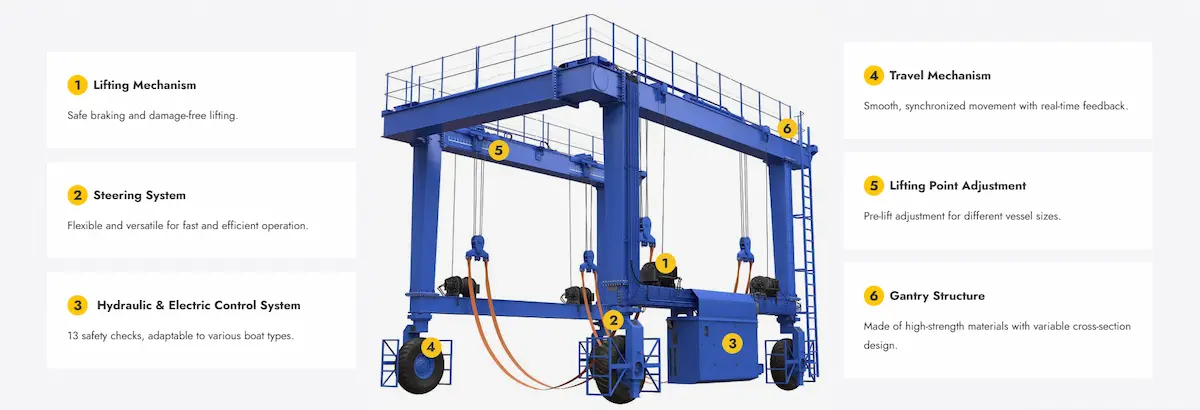
●Preliminary engineering design and technical verification: Custom projects start from site conditions, vessel parameters, and load calculations. Structural checking and simulation verification may be needed. This is real design investment.
●Non-standard parts manufacturing and procurement: Non-standard parts often have small batches and many processes. Procurement cycles and unit prices are less controllable than standard parts. Repeated confirmation and rework are also likely.
●Special materials and core component selection: Special materials and core component selection affect price and delivery. High-strength steel, special hydraulic components, anti-corrosion materials, and branded parts are examples. More expensive is not always better. The key is matching working conditions.
●Factory assembly, testing, and commissioning: Factory assembly, testing, and commissioning cost more for custom equipment. Assembly is harder, and commissioning and load testing take longer. Factory labor and site occupancy also increase costs.
●Special transportation, site installation, and commissioning services: Special transportation, site installation, and commissioning services often need separate quotes. Oversized transport, site lifting, installation guidance, and commissioning are examples. Define transport boundaries and site coordination responsibilities early.
In the end, custom pricing is not “standard price plus options.” It is a new account from design to delivery. The more special the parameters, the higher the share of early design and later service.
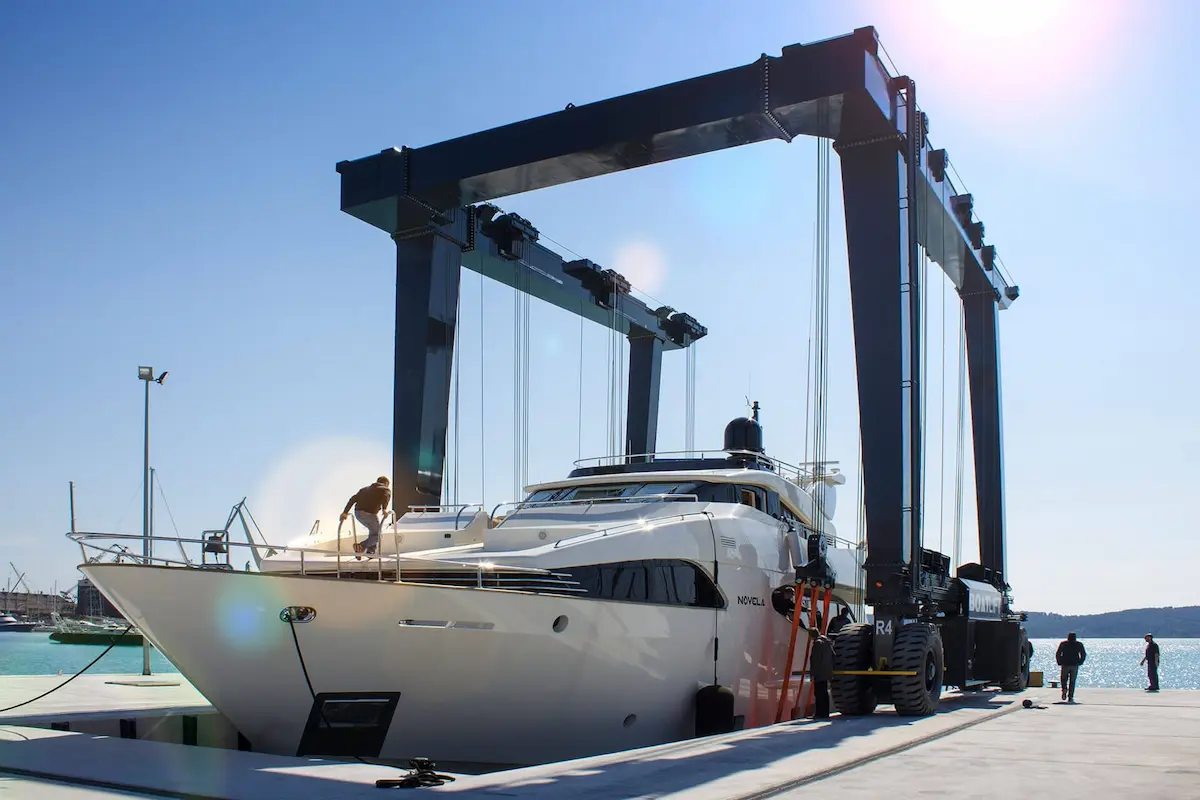
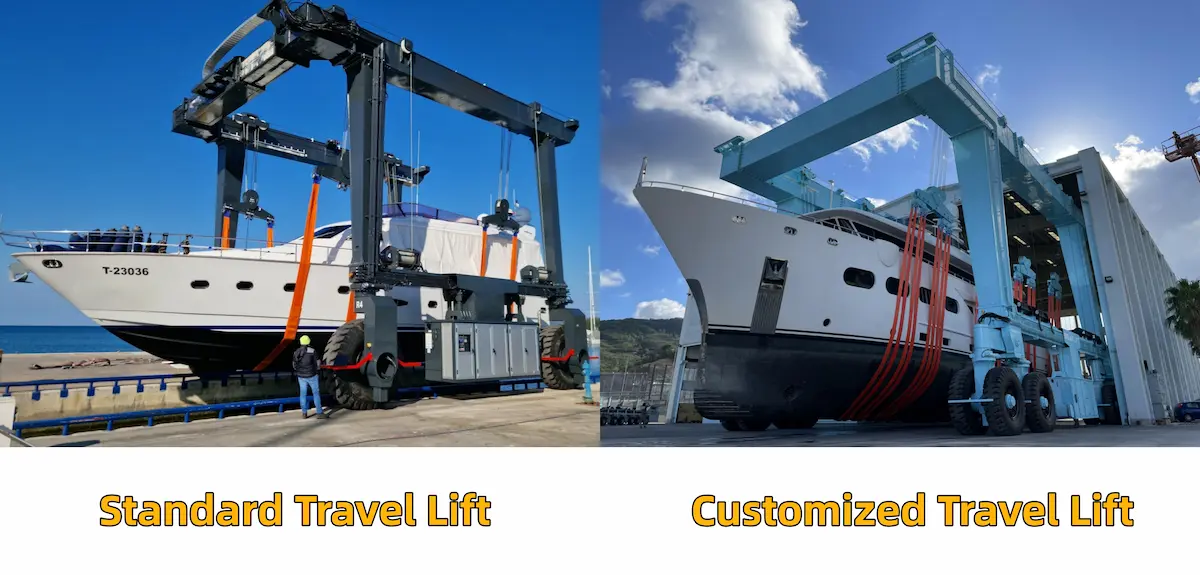
This table supports travel lift procurement analysis; it’s not a quotation. “Standard” and “custom” boundaries vary by manufacturer. Focus on where differences occur, not labels.
|
Dimension |
Standard travel lift |
Custom travel lift |
Meaning for procurement judgment |
| Design cycle (drawing to production) | About 2–3 weeks; minor drawing changes. | About 6–10 weeks; calculations, checks, confirmations. | Tight windows favor standard delivery. Reserve custom design confirmation time. Freeze design before production. |
| Non-standard parts share | Typically 10%–20%; common and standard parts. | Typically 40%–60%; gantry, wheels, lifting points, electrical control. | Higher share worsens spare commonality and lengthens procurement. Require suppliers to list non-standard parts for later spare management. |
| Typical price difference at same capacity | Base price. | Usually 30%–80% higher; depends on non-standard degree. | Not fixed. Span, steering, synchronization, and anti-corrosion each raise it. Ask for itemized change quotes. |
| Site measurement requirements | Parameter selection plus site verification. | Measure passage width, clearance, bearing, and slope; errors affect structure. | Inaccurate custom measurement causes rework. Define measuring party and recheck points in the contract. |
| Configuration change/rework risk | Later span, lifting point, or steering changes are non-standard rework; cost and delivery rise. | Locked parameters need rechecking after change; reserved interfaces cost less. | Standard fears late changes; custom fears unclear planning. Limited budgets should confirm site limits first and reserve interfaces in the agreement. |
| Delivery cycle and commissioning complexity | Usually 3–5 months; mature commissioning. | Usually 6–10 months; longer assembly, testing, and commissioning. | Schedule factory and site commissioning separately; avoid reverse-scheduling by manufacturing alone. |
The most common mistake in travel lift procurement is comparing several quotes side by side. Then choose the lowest number. Equipment quotes are only the entry point. The real gap often appears in operating accounts over later years.
●Equipment energy consumption and daily operating costs: Hydraulic system efficiency, travel frequency, standby time, and operating habits affect energy use. A custom solution optimized for the work flow may lower energy per lift. But overly complex configurations may not save daily operation.
●Maintenance and spare part replacement costs: Standard parts are common, easy to find, and relatively transparent in price. Non-standard parts depend on supplier spare part capability. Ask for the wear part list, replacement cycle, and spare prices during procurement. Do not wait until failure to ask.
●Impact of marine environment on equipment life-cycle cost: Salt spray, humidity, and seaside dust accelerate aging of steel structures, hydraulic parts, and electrical components. If anti-corrosion grade is too low, early savings often go to rust removal, repainting, and part replacement.
●Calculation of travel lift full life-cycle cost: A practical formula is initial purchase price plus installation and commissioning. Add energy, maintenance spares, anti-corrosion repair, and downtime loss. Then spread over service years to get annual average cost. Comparing solutions under the same basis is usually more reliable than quotes alone.
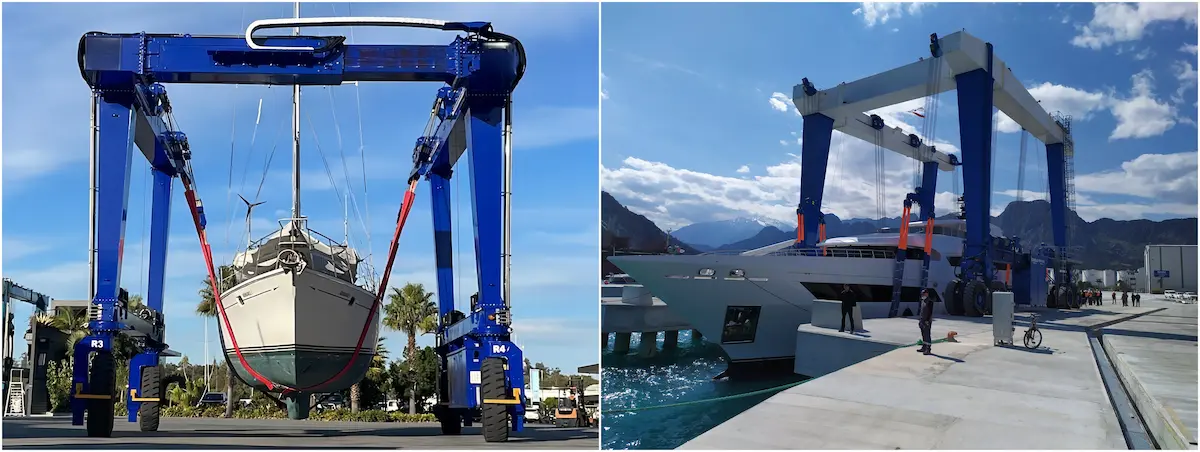
Customization is not configuration stacking. HSCRANE grades by working conditions, defines structure by grade, and spends limited budget on safety and long-term use.
●Flexible customization within standard frameworks: HSCRANE adjusts mature gantry and travel platforms parametrically for vessel, site, and ground bearing. ISO 4301 U0–U9 and Q0–Q5 set design groups A1–A8; mechanisms follow FEM 9.511:1986. Yacht docks fall in FEM 2m–3m/ISO A3–A6. High-frequency sites move up one grade, avoiding excess performance.
●Optimized steel structure to FEM and EN limit states: FEA checks stress and deformation. Design follows FEM 1.001 (1998) classification and load combinations, referencing EN 13001-1:2015 and EN 13001-2:2021. It covers yield, fatigue, and elastic instability, clarifying what not to cut and removing optimizable material.
●Hydraulic drive and multi-mode steering matched to passages: Standard travel handles conventional dock transfers. Narrow, turning sites can add crab, pivot, or coordinated steering. Cover actual routes, not every mode, and avoid paying for low-frequency conditions.
●Multi-point synchronous lifting and load balancing: High-value yachts need uniform sling loads. PLC and multi-point monitoring adjust synchronization in real time, reducing hull deformation risk. It suits long lifts and low-rigidity hulls; small conventional vessels may not need it.
●Marine anti-corrosion and long-term maintenance: Grades follow actual salt spray exposure; avoid the highest grade everywhere. Seaside equipment needs more coating and electrical protection; sheltered sites prioritize maintainable structures and spare commonality. ISO 4301 level affects life expectancy—too high wastes money; too low raises maintenance.
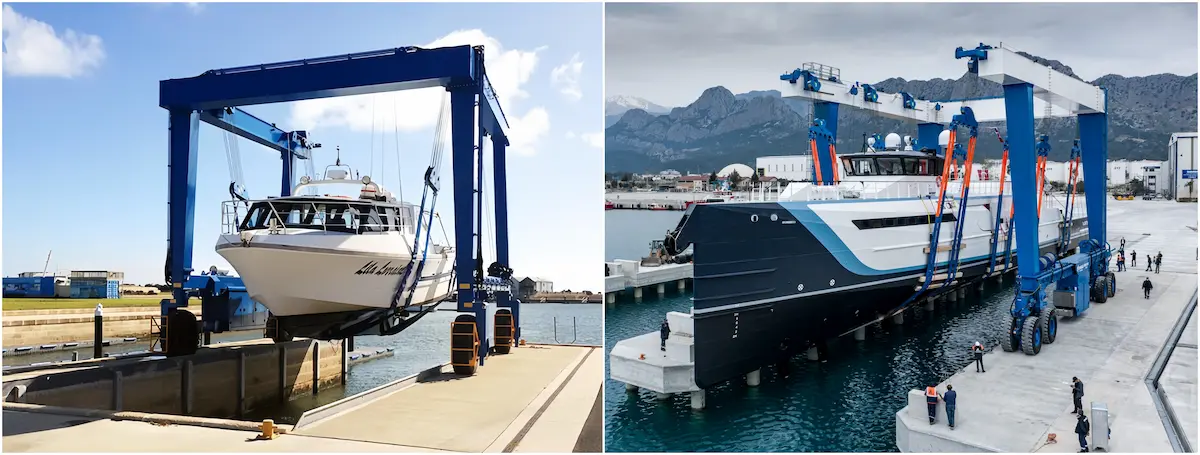
●Customer and project background: The customer is Sentosa Marina in Singapore. It is a high-end yacht berthing and maintenance hub in Southeast Asia. In 2025, the marina started expansion and upgrading. It needed a high-capacity Travel Lift for launching, hauling out, and maintenance lifting. The project team selected HSCRANE after multiple technical comparisons. HSCRANE provided a custom solution.
●Site constraints and quantified configuration: The dock serves wide-hull yachts. Maximum beam approaches the 30-meter class. Passage and berth layouts do not allow unlimited equipment outline growth. HSCRANE configured a Travel Lift with 18-meter span and 12-meter lifting height. Rated capacity is 160 tons. It uses hydraulic drive and variable-frequency control. It offers ground remote and cabin dual-mode operation. The 18-meter span is a tradeoff between target beam coverage and passage boundaries. It is not a template applied directly by tonnage.
●Protection measures for high-value hulls: The lifting system uses high-strength slings with intelligent anti-sway control. This reduces lateral swing and impact during lifting and travel. For luxury yacht docks, hull surface repair costs far exceed sling costs. This configuration has higher priority than simply adding structural thickness.
Delivery results: After commissioning, yacht launch and haul-out time shortened by about 30%. Maintenance scheduling flexibility also improved. The dock feedback focuses on two points. Positioning in narrow areas no longer requires repeated vehicle moves. Dual operation modes switch between good ground visibility and cabin control. Actual single-person efficiency is higher than expected.
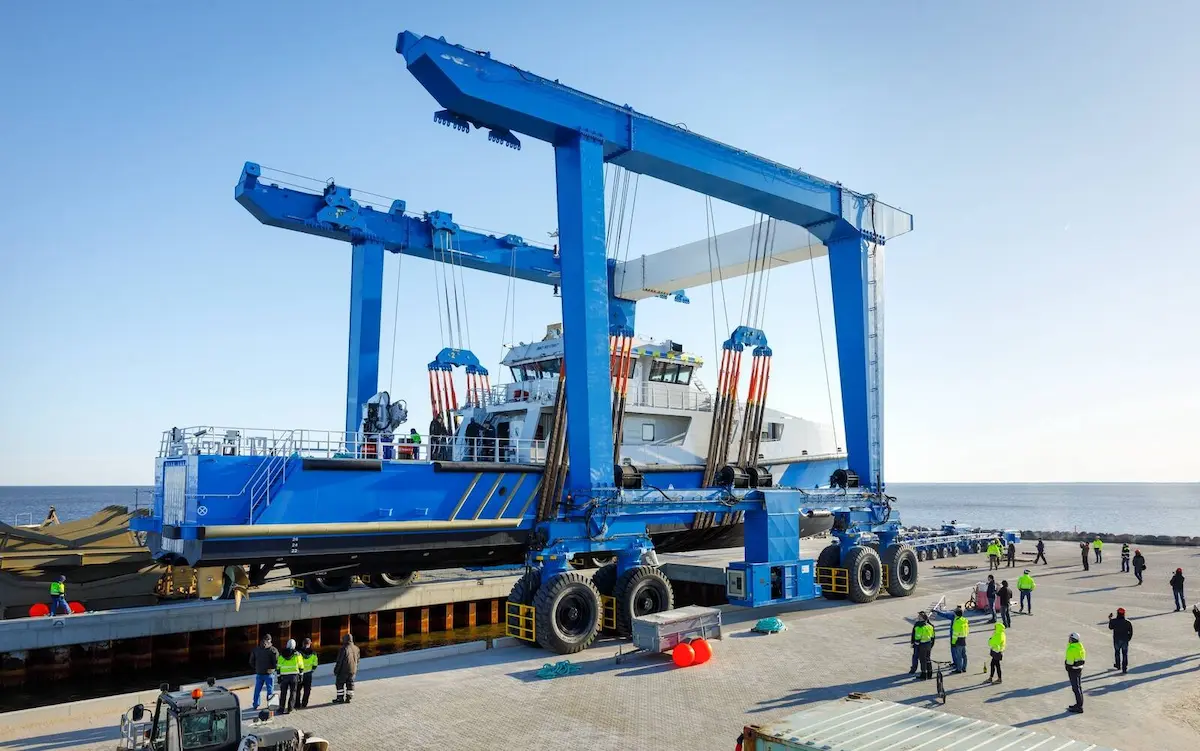
●Customer and project background: The Croatia Split high-end yacht dock is on the Adriatic coast. It serves 40 to 60-meter luxury yachts year-round. The original 150-ton equipment can no longer meet growing large-yacht lifting needs. The customer needed a safe, weather-resistant, and efficient heavy-duty solution. HSCRANE customized a 300-ton mobile travel lift.
●Quantified configuration of the Croatia project: The configuration is a 300-ton mobile travel lift. Its maximum vessel length is 55 meters, and maximum beam is 10 meters. Lifting height is 16 meters, and clear span is 12 meters. It has 16 sets of heavy-duty solid tires. It offers front-wheel, crab, pivot, and synchronous steering modes. The core is not “300 tons” itself. It is the combination of tire count and steering modes. This lets a large-capacity machine position in Split’s limited turning space.
●Custom investment for high-value yachts: The structure uses finite element optimization. Main structure anti-corrosion coating total thickness exceeds 320 μm. It includes PLC multi-point load monitoring and real-time sling force adjustment. 125% static and 110% dynamic load tests follow European safety standards. All-electric drive cuts energy use by about 40% versus conventional diesel. Maintenance costs fall by about 35%. For a high-end dock operating year-round, this operating difference weighs as much as initial quotes in procurement decisions.
●Looking at both cases together: The commonality between Singapore and Croatia is not tonnage. It is tight sites, high vessel value, and high downtime loss. Custom design money mainly goes to fewer vehicle moves in restricted spaces. It also makes sling loads more uniform. It lets anti-corrosion and power configurations support long-term operation. Tonnage is only the entry point. Working conditions anchor pricing.
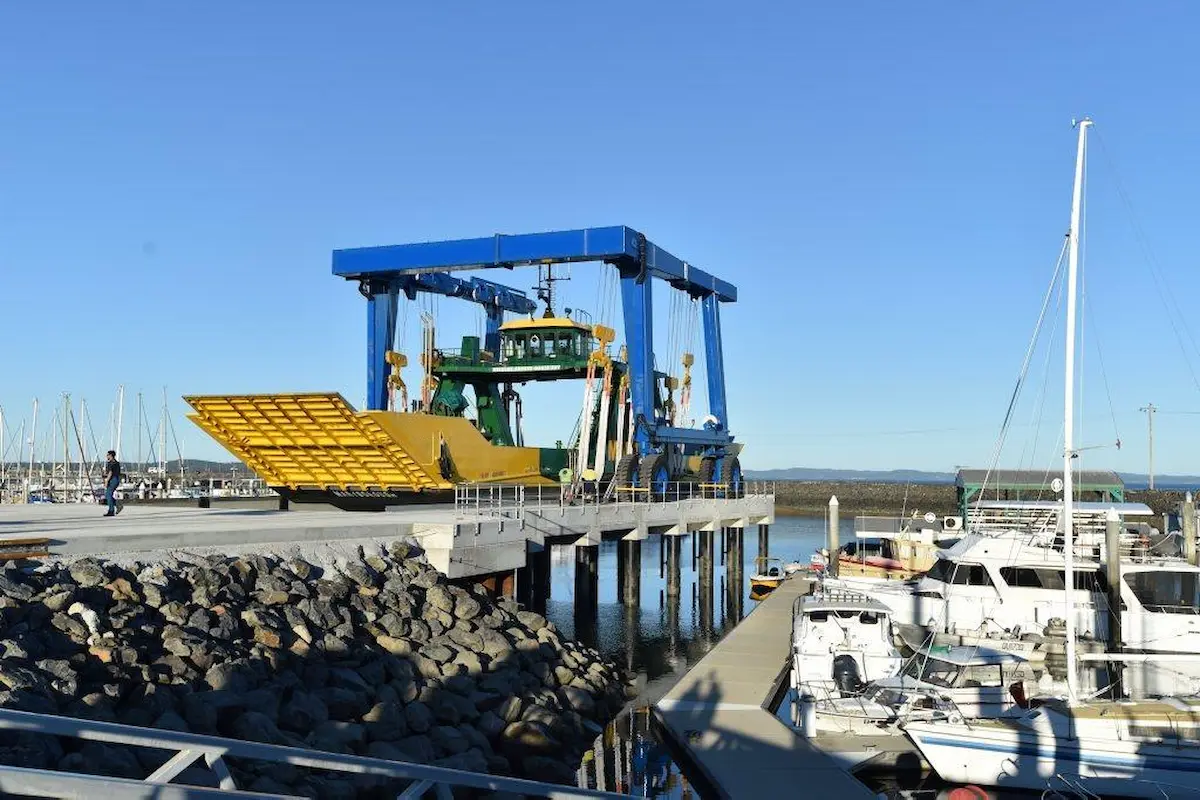
Budgets suffer most when quotes are rushed with incomplete information. A low quote leads to add-on costs later. A high quote includes unneeded configurations. A reasonable approach is to clarify your own basics first. Then compare quotes using the same information set.
Among these six, the first three define selection. The last three define environment and operating costs. Miss one item, and the quote’s reference value drops.
|
Information to clarify |
Why budget is affected |
If inaccurate |
| Maximum yacht weight and future tonnage | Sets rated capacity and structure grade. Keep margin for the heaviest vessel. | Too tight blocks larger vessels. Oversizing raises structure, hydraulic, travel costs. |
| Maximum beam, shipyard, and hull structure | Beam sets span and sling spacing. Hull sets lifting points. | Tonnage alone forces conventional sizing. Later span/point changes cost extra. |
| Dock passage width and site size | Sets outline, turning, steering modes. Narrow passages may need crab/pivot steering. | Conventional quote may not turn on site. Equipment or site changes cost. |
| Ground bearing and slope | Wheel loads depend on slab thickness, strength, and slope. Typical flatness is about 3‰. Ramps of 2%–4% are allowed. Large units need more. | Weak bearing needs more wheels or foundation work. This is often outside equipment quotes. |
| Daily lifts and frequency | Sets working class and key parts. High-frequency continuous use needs a higher grade. | Low-frequency quote under high-frequency use shows later life and downtime costs. |
| Climate, salt spray, and power | Salt spray sets anti-corrosion grade. Coastal areas often need C4+ under ISO 9223. Power affects drive/control. | Ordinary-environment quotes may corrode in 1–2 years. Repair and downtime exceed savings. |
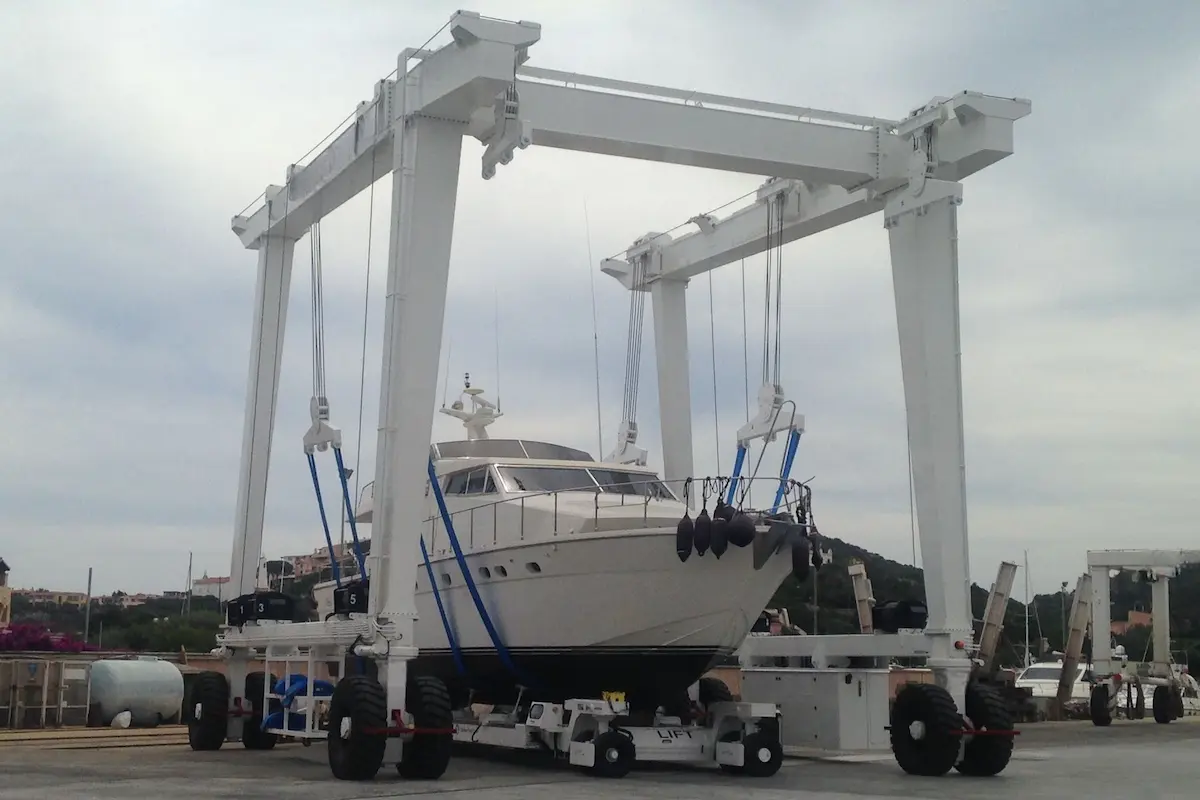
Do not look only at total price. Check the items below one by one. This is more useful than bargaining back and forth.
●Boundary between base and optional configurations: Align capacity, span, lifting height, sling count, control, and safety protection. List included and excluded items specifically. Do not let options become “should be included.”
●Separate line items for non-standard design and extra manufacturing: For deviations in span, gantry, lifting points, or travel system, require separate design and manufacturing fees. Do not bundle them into the total.
●Delivery boundary for transport, installation, and commissioning: Many quotes cover only equipment. Transport, site installation, commissioning, and embedded parts may be extra. Ask clearly whether terms are EXW, FOB, or delivered with installation.
●Spare parts supply and after-sales scope: Ask for wear part list, supply method, and response mechanism. Responsive spares for slings, seals, and tires control downtime. Put after-sales scope in writing.
●Warranty period and maintenance requirements: Check warranty scope separately for structures, hydraulics, and electrical components. Confirm whether mandatory maintenance affects claims. Do not ask only “how long?”
●Later expansion and upgrade possibilities: Whether future functions can be added matters more than buying them now. Reserved interfaces for synchronization, remote control, and higher anti-corrosion make upgrades controllable. Without them, future work modifies equipment. With limited budget, reserve interfaces first and delay functions.
Use the travel lift procurement information sheet with the confirmation checklist. Then quotes become comparable. Send the same site conditions to three suppliers. Require the same format for equipment, non-standard items, transport and installation, spare parts and after-sales, and warranty. Only then can the final numbers support budgeting.
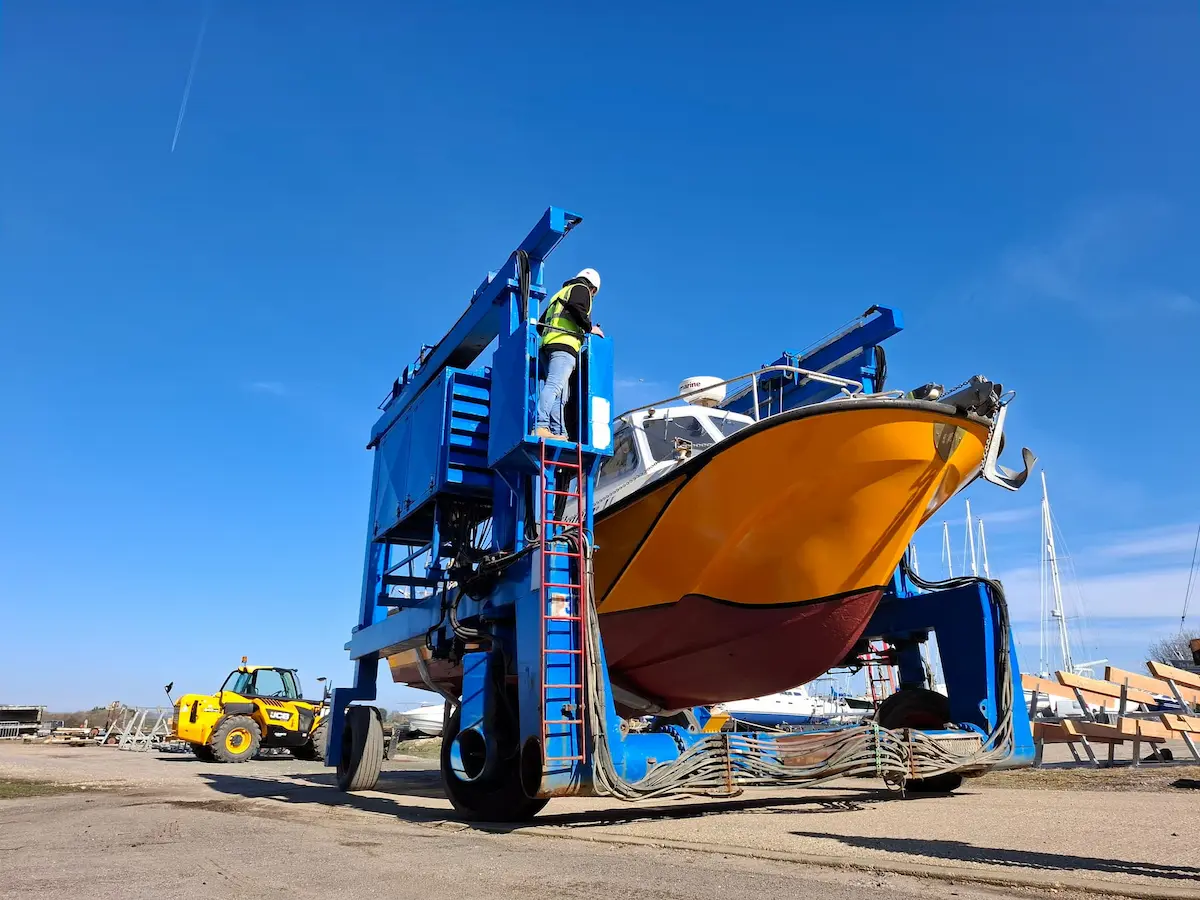
Travel lift procurement is not about choosing the largest parameters or lowest quote. It aligns vessel type, site, ground bearing, frequency, and anti-corrosion environment first. Then judge whether standard is sufficient and custom is worth the cost. Standard advantages are maturity and controllable delivery. Custom value is matching special conditions. Budget reasonableness depends on fewer problems, downtime, and rework over the life cycle. Accurate early information and clear quote boundaries help more than later bargaining.
Suitable equipment configuration affects initial procurement cost and later operating efficiency and maintenance. If you are buying new equipment or upgrading dock lifting capacity, contact HSCRANE. Provide vessel weight, dimensions, and site information. We can further evaluate a suitable equipment solution.
[Contact HSCRANE Now for a Project Quote]
Equipment selection and site matching are set. The next easily ignored issue is travel speed settings. Under loaded and unloaded conditions, conservative speed affects efficiency. Aggressive speed harms structure and hydraulic systems. If you are commissioning a travel lift or training operators, read this next:
Click to read: How to Set Mobile Boat Hoist Travel Speed: Loaded vs. Unloaded Operation
Q1: Is a standard travel lift always cheaper than a custom one?
Not necessarily. Standard models usually cost less in conventional conditions. Narrow passages, limited bearing, or large spans may cost more. Later changes can exceed custom costs. Excess options also raise budgets.
Q2: Why not judge equipment price only by rated capacity?
In travel lift procurement, rated capacity is an entry point. Two 100-ton units can differ in price. Span, height, slings, travel, and anti-corrosion vary. Provide span, clearance, wheel load, and frequency for comparison.
Q3: Where does the extra money for a custom travel lift mainly go?
It mainly goes to three areas. Early engineering design and verification come first. Non-standard parts and special materials come second. Factory assembly, commissioning, and site installation come third. Structure calculation, lifting point layout, and synchronization commissioning often cost most.
Q4: What information is most easily ignored before travel lift procurement?
Ground bearing and salt spray are often ignored. People focus on tonnage and span. Weak bearing needs more wheels or foundation work. Inaccurate salt spray data leads to ordinary anti-corrosion. Rust may appear in one or two years. These extra costs often fall outside equipment quotes.
Q5: Which configurations can wait when budget is limited?
Multi-point synchronization, remote control, and higher automation can wait if unused now. Keep interfaces and delay functions. Do not cut basic safety protection, structural strength, or site-matched anti-corrosion. Prioritize matching and safety before intelligence and expansion.
This document is for reference only. Specific operations must strictly comply with local laws and regulations and equipment manuals.