Main Product
Our company's products are widely sold in multiple countries
Liscont Container Terminal at the Port of Lisbon, Portugal, is operated by YILPORT Holding. It is an important deep-water container hub on the Atlantic coast of the Iberian Peninsula. Yard workload has continued to rise. Existing rubber tyred gantry cranes struggled to match peak handling pace. They also fell short in twin-container efficiency and equipment availability. After multiple technical comparisons, the terminal operator chose the HSCRANE 35+15 t rubber tyred gantry crane. It offers coordinated main and auxiliary spreader operation. The goal is higher yard throughput per unit area and lower energy use per container. The project requires CE certification and FEM standards. The equipment must also keep continuous availability under Atlantic high wind pressure and salt spray corrosion.
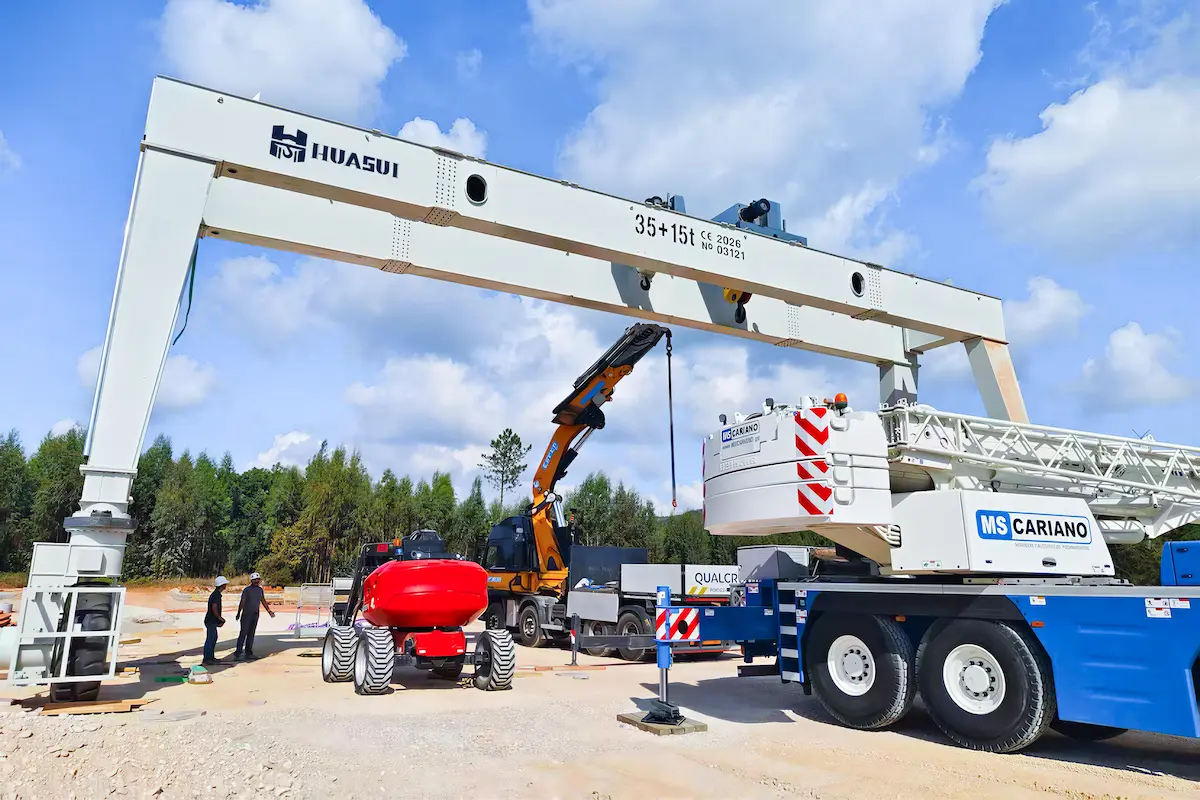
The HSCRANE 35+15 t rubber tyred gantry crane is customized on a mature rubber tyred gantry crane platform. Main hoist rated load is 35 t. Auxiliary hoist/spreader rated load is 15 t. It handles 20 ft, 40 ft, and 45 ft containers in yard loading, unloading, and transfer. Main technical specifications are below.
|
Parameter |
Technical Specification |
| Main hoist rated load | 35 t |
| Auxiliary hoist/spreader rated load | 15 t |
| Span | 23.47 m (customizable to 26 m) |
| Lift height | 15.5 m (4-high stacking; extendable to 18.5 m / 5-high) |
| Wheelbase | 7.0 m / 7.5 m |
| Container specifications | 20 ft / 40 ft / 45 ft |
| Hoisting speed (full load/empty) | 20/40 — 25/50 m/min |
| Gantry travel speed (full load/empty) | 30/130 m/min |
| Trolley travel speed | 70 m/min |
| Wheel configuration | 8–16 wheels |
| Power supply | Diesel generator set / cable reel / lithium battery system / three-phase mains |
| Design standards | CE, ISO 9001, FEM 9.511, GB/T 3811 |
Among these parameters, the 35 t main hoist covers laden container handling. The 15 t auxiliary hoist serves empty containers and auxiliary lifting. Coordinated dual spreaders reduce trolley trips. This offers clear cycle advantages in laden-in-empty-out or empty-in-laden-out yard operations. The rubber tyred gantry crane uses PLC speed control, anti-collision protection, and night lighting. It suits continuous multi-shift operation.
Rubber Tyred Gantry Crane Installation Process
The site is inside the existing Liscont terminal yard. The construction window is strictly constrained by terminal production plans. Installation must not interrupt adjacent container block handling. The team controls these key points.
●Foundation and track verification: The rubber tyred gantry crane is trackless on tyres. It is sensitive to yard ground bearing and flatness. Before installation, re-measure pavement strength, drainage slope, and turning radius. Ensure 8–16 wheel load distribution meets design requirements. Avoid local settlement causing deviation.
●Modular structure assembly: Transport the gantry and main girder separately. Connect them on site with high-strength bolts. Schedule column lifting and girder closing in low-wind periods. After closing, re-measure gauge, diagonal, and camber. Keep geometric deviation within FEM allowable range.
●Electrical and drive connection: Use cable reel power supply based on terminal conditions. Complete reel tension calibration, limit interlock, and grounding tests. Import anti-sway parameters and yard coordinates into the PLC. Achieve basic data interface with the terminal operating system.
●Dual spreader commissioning: Test the 35 t main and 15 t auxiliary spreaders without load. Perform rated load and 1.1 times static load tests. Verify switching logic, brake synchronism, and overload thresholds. Check interference boundaries for alternating 40 ft positions. Ensure no action sequence conflict.
●Environmental adaptability verification: Test wind anchors and rail clamps for Atlantic wind loads. Inspect cabinet sealing and coatings under salt spray. Confirm anti-corrosion performance meets long-term exposure requirements.
Rubber Tyred Gantry Crane Installation Process
After installation, the rubber tyred gantry crane passes no-load function tests. It then passes rated load tests, static load tests, and continuous operation reliability trials. Trials use actual yard container flow as load. Time mixed cycles of 35 t laden and 15 t empty containers. Verify efficiency gains of the dual-spreader configuration under real production pace. The terminal engineering team and a third-party inspection agency review all test data. The equipment then enters commercial operation. Delivery documents cover structural calculations, electrical schematics, FEM/CE conformity declarations, operation and maintenance manuals, and spare parts lists. On-site training covers main and auxiliary spreader operation, daily inspection, and fault diagnosis for terminal operators and maintenance staff.
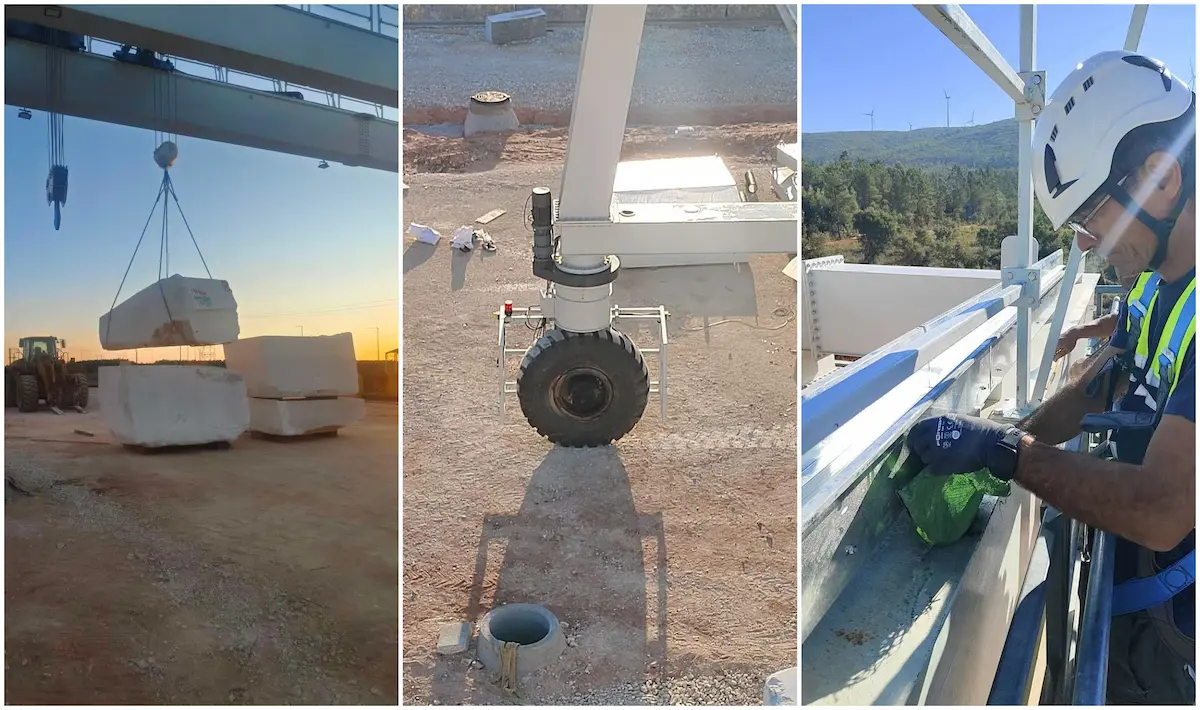
Successful installation and delivery of the HSCRANE 35+15 t rubber tyred gantry crane at Portugal’s Liscont container terminal verified engineering applicability. The dual-spreader rubber tyred gantry crane configuration suits Atlantic coastal port yards on the Iberian Peninsula. The project completed modular assembly, electrical connection, and dual-spreader commissioning without stopping existing operations. Measured equipment parameters match FEM and CE requirements. The case shows that 35 t main lift and 15 t auxiliary lift can match cycles. This works for laden and empty containers in limited yard space. It provides a reference technical path for yard equipment upgrades in Portugal and Southern Europe. HSCRANE’s wind-load installation procedures and dual-spreader commissioning process can be reused in later regional projects.